EcoFlow DELTA Power Stations: Which One Fits Your Setup?
Every figure on this page is quoted from the Amazon listing for that model. Scores are the average rating Amazon buyers left. Nothing here was handled or measured by us.
As Amazon Associates, we earn from qualifying purchases. This means we may receive a small commission at no extra cost to you if you click through and make a purchase.
If you typed “coflow portable power station,” you were most likely looking for EcoFlow, and the real question is which DELTA model fits your gear. A typical console, a gaming monitor and a Wi-Fi router together draw somewhere around 250 to 300 watts while you play. Using that rough load and allowing for inverter losses, a 1024Wh DELTA keeps that setup running for about three hours, a 2048Wh model for around six, and the 3600Wh DELTA Pro for around ten. A high-end gaming PC can easily double the load and halve those numbers.
This article compares five EcoFlow power stations: the DELTA 3 Classic, the DELTA 3 Max, the DELTA Pro, the DELTA 3 Plus and a DELTA 3 Max bundle with a 220W solar panel. They differ in capacity (1024Wh to 3600Wh), continuous output, charging speed and expandability. We worked from the listings and specifications, not our own runtime tests, and the estimates above are simple math you can redo with your own devices.
JOB SHEET
Which EcoFlow Portable Power Station Should You Buy
- For a single console or PC with UPS protection during short outages: EF ECOFLOW Portable Power Station Delta 3 Classic
go to no. 01 - For long blackouts with a monitor, console and router all running: EF ECOFLOW DELTA 3 Max Portable Power Station
go to no. 02 - For whole-room backup, big loads and room to expand: EF ECOFLOW Portable Power Station 3600Wh DELTA Pro
go to no. 03 - For a 1024Wh unit you can grow later: EF ECOFLOW Portable Power Station DELTA 3 Plus
go to no. 04 - For an off-grid campsite LAN party with solar recharging: EF ECOFLOW DELTA 3 MAX Portable Power Station with solar panel
go to no. 05
No. 01
of 5
EF Ecoflow
EF ECOFLOW Portable Power Station Delta 3 Classic

4.1
out of 5
Amazon buyer average
Affiliate link. Price and stock live at Amazon and change there, not on this page.
Best for
Expandable mid-size backup for a NAS
Pros
- 1024Wh, expandable to 5kWh
- 1500W AC input, 80% in 40 min
- IP65 battery pack
- Powers 13 devices at once
Cons
- Same base capacity as Classic
- Spec sheet lists odd engine fields
Best for
Whole-room backup and big LAN events
Pros
- 3600Wh, expandable to 25kWh
- 3600W AC, 4500W X-Boost
- 15 output methods
- Five charging methods
Cons
- Largest and heaviest option
- Some spec fields read like generator data
Best for
Keeping one gaming setup alive through outages
Pros
- 1024Wh LiFePO4 battery
- 1800W output, 3600W surge
- Under 10ms UPS switchover
- 0-80% in 45 minutes
Cons
- No extra battery expansion
- Smallest capacity here
The EF ECOFLOW Portable Power Station Delta 3 Classic is the entry point to the DELTA range. It pairs a 1024Wh LiFePO4 battery with 1800W of continuous AC output and a 3600W surge, and X-Boost lets it run resistive loads up to 2600W. X-Stream AC charging takes it from 0 to 80% in 45 minutes, and a 500W solar panel (sold separately) recharges it in about 2.5 hours according to EcoFlow.
The feature that matters most for gamers is the UPS function. The listing says it switches to battery in under 10ms, fast enough to keep a PC or console running when the grid drops, so you do not lose an unsaved match or corrupt a download. EcoFlow rates the cells for more than 10 years of daily use, and the app offers Storm Alert and Self-Powered Mode.
The trade-off is expansion. The listing states it is not compatible with the DELTA 2 or DELTA 3 Series Smart Extra Batteries, so 1024Wh is what you get. If you want the same capacity with room to grow, the DELTA 3 Plus is the better fit.
- 1024Wh LiFePO4, 1800W output, 3600W surge
- Under 10ms UPS switchover
- 0 to 80% in 45 minutes on AC
- Not compatible with extra batteries
No. 02
of 5
EF Ecoflow
EF ECOFLOW DELTA 3 Max Portable Power Station

4.9
out of 5
Amazon buyer average
Well rated
4.6 or better out of 5 on Amazon
Affiliate link. Price and stock live at Amazon and change there, not on this page.
Best for
Off-grid LAN camps with solar
Pros
- Includes 220W solar panel
- 2048Wh LFP battery
- 3400W X-Boost output
- Under 10ms transfer time
Cons
- Starting and running watts conflict
- Single panel limits solar speed
Best for
Long outages and multi-screen setups
Pros
- 2048Wh LFP battery
- 3400W X-Boost output
- Under 10ms transfer time
- 0-80% in 1.13 hours
Cons
- Listing output figures conflict
- Solar panel sold separately
The EF ECOFLOW DELTA 3 Max Portable power station doubles the Classic’s storage with a 2048Wh LFP battery. The title lists 2400W of output, and the features describe up to 3400W continuous in X-Boost mode for high-demand appliances. The listing specs mix these figures (output 2400W, running wattage 3400W), so treat 2400W as standard output and 3400W as the X-Boost ceiling.
X-Stream charging goes from 0 to 80% in 1.13 hours, the transfer time is under 10ms for UPS use, and EcoFlow highlights ultra-quiet operation, which matters if the unit sits in the same room where you are streaming or recording. The listing does not give a weight but describes the design as lighter and built for 10 years of daily use.
This model suits a reader who wants to keep a full setup running through an evening-long outage, roughly six hours with a console, monitor and router by our rough math. If you want solar in the box, the bundle further down includes a panel.
- 2048Wh LFP battery
- Up to 3400W X-Boost output
- 0 to 80% in 1.13 hours
- Under 10ms transfer time
No. 03
of 5
EF Ecoflow
EF ECOFLOW Portable Power Station 3600Wh DELTA Pro

4.6
out of 5
Amazon buyer average
Well rated
4.6 or better out of 5 on Amazon
Affiliate link. Price and stock live at Amazon and change there, not on this page.
The EF ECOFLOW Portable Power Station 3600Wh DELTA Pro is the heavy hitter. It stores 3600Wh in an LFP battery and delivers 3600W of AC output, up to 4500W with X-Boost. Two units can pair for 7200W, and with DELTA Pro Extra Batteries or Smart Generators the capacity expands from 3.6kWh to 25kWh.
It has 15 output methods and five ways to charge: wall outlet, solar, EV charging station, EcoFlow smart generator and car outlet. X-Stream recharges it in 1.8 hours on a 240V outlet at 3000W, 2.7 hours on a standard 1800W outlet, or 2.8 hours with four 400W solar panels. The app works over Wi-Fi or Bluetooth. Some spec fields, such as “Engine Type: 4 Stroke,” look like generator template data and do not describe a battery station.
This is the pick for hosting a LAN party with several rigs, backing up a whole home office or running a gaming room through a long outage. For one console and a monitor, it is far more than you need. For a look at comparable high-capacity units, our guide to large home backup power stations shows how other lineups compare.
- 3600Wh, expandable to 25kWh
- 3600W AC, 4500W with X-Boost, 7200W paired
- 15 outputs and five charging methods
No. 04
of 5
EF Ecoflow
EF ECOFLOW Portable Power Station DELTA 3 Plus

4.7
out of 5
Amazon buyer average
Well rated
4.6 or better out of 5 on Amazon
Affiliate link. Price and stock live at Amazon and change there, not on this page.
The EF ECOFLOW Portable Power Station DELTA 3 Plus shares the Classic’s 1024Wh and 1800W figures but adds expandability and faster charging. It accepts DELTA 3, DELTA Pro 3 or DELTA 2 Max battery packs to reach up to 5kWh. With 1500W AC input it charges to 80% in 40 minutes, and the listing lists five charging options including solar, an 800W alternator and hybrid AC plus solar.
The LFP cells are rated for 4000 cycles to 80%, and the battery pack carries an IP65 rating against splashes, dust and oil. It works as a UPS with a 10ms switch-over, and EcoFlow specifically names NAS and servers, handy if you keep a media server or game library on network storage. It can power 13 appliances at once, and X-Boost supports resistive loads over 2200W. The spec sheet also lists an engine displacement of 79 cubic centimeters, which does not make sense for a battery unit, so ignore that field.
Choose the Plus over the Classic if there is any chance you will want more runtime later. If you already know you need 2048Wh, the DELTA 3 Max gets there without add-ons. Compact alternatives are covered in our portable power station roundup.
- 1024Wh, expandable up to 5kWh
- 80% charge in 40 minutes with 1500W AC input
- IP65 battery pack, 4000 cycles to 80%
- 10ms UPS switch-over
No. 05
of 5
EF Ecoflow
EF ECOFLOW DELTA 3 MAX Portable Power Station with Solar Panel

4.8
out of 5
Amazon buyer average
Well rated
4.6 or better out of 5 on Amazon
Affiliate link. Price and stock live at Amazon and change there, not on this page.
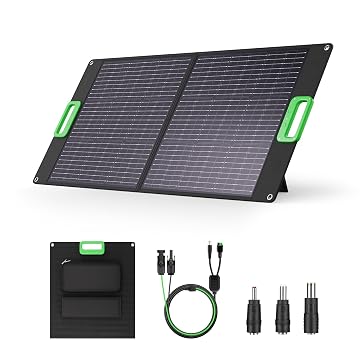
The EF ECOFLOW DELTA 3 MAX Portable bundle pairs the same 2048Wh DELTA 3 Max with a 220W solar panel, according to the title. It shares the 3400W X-Boost output, 0 to 80% in 1.13 hours on X-Stream and under 10ms transfer time. The listing gives dimensions of 19.5 x 9.4 x 12 inches and an aluminum, plastic and metal build.
The specs conflict slightly, listing 2400W starting wattage and 3400W running wattage. The listing does not specify how long the 220W panel takes to refill the battery. As general guidance, a single 220W panel produces less than its rating in real sun, so a full recharge from solar alone takes most of a sunny day or more.
This bundle suits the camping LAN crowd: set up a console and a portable monitor at a campsite, run them in the evening and let the panel top up the battery during the day. If you will mostly charge from the wall at home, the standalone DELTA 3 Max does the same job without the panel.
- 2048Wh battery with 220W solar panel
- 3400W X-Boost output
- Under 10ms transfer time
What Sets These Models Apart
| Model | Capacity | Output | Expansion |
|---|---|---|---|
| DELTA 3 Classic | 1024Wh | 1800W (3600W surge) | Not compatible with extra batteries |
| DELTA 3 Max | 2048Wh | 2400W, 3400W X-Boost | Listing does not specify |
| DELTA Pro | 3600Wh | 3600W, 4500W X-Boost | Up to 25kWh |
| DELTA 3 Plus | 1024Wh | 1800W | Up to 5kWh |
| DELTA 3 Max with Solar Panel | 2048Wh | 2400W, 3400W X-Boost | Listing does not specify; 220W panel included |
Figures in this table are copied from the Amazon listings for these models.
NOTES
Buying Tips for EcoFlow Portable Power Stations
Start with your real load. Add up the wattage of your console or PC, monitor, router and any speakers, then divide the station’s capacity by that number and knock off roughly 15% for inverter losses. That gives a fair runtime estimate. A gaming PC under full load draws far more than a console, so size up if you play on a desktop.
Next, decide whether you need UPS behavior. All the DELTA 3 models list a switchover of 10ms or less, which lets them sit between the wall and your rig so an outage does not interrupt play. The DELTA Pro listing does not state a UPS time. For power tool and jobsite-focused units, see our guide to rugged jobsite power stations.
Finally, think about growth. The Classic cannot expand, the Plus reaches 5kWh and the Pro reaches 25kWh. Buying the right platform now saves replacing the whole unit later.
FAQ
How long will an EcoFlow DELTA run a gaming console?
With a console, monitor and router drawing about 250 to 300 watts, expect roughly three hours from a 1024Wh DELTA, six from a 2048Wh model and ten from the 3600Wh DELTA Pro. These are estimates, not test results.
What is the difference between the DELTA 3 Classic and DELTA 3 Plus?
Both list 1024Wh and 1800W. The Plus adds expansion up to 5kWh, a 1500W AC input with 80% in 40 minutes and an IP65 battery pack. The Classic cannot take extra batteries.
Can an EcoFlow DELTA work as a UPS for my PC?
The DELTA 3 Classic, DELTA 3 Plus and DELTA 3 Max all list a switchover of 10ms or less, designed to keep PCs and servers running during outages.
Does the DELTA 3 Max come with a solar panel?
The standalone DELTA 3 Max does not. The separate bundle listing includes a 220W solar panel with the same 2048Wh unit.
Is "coflow" the same as EcoFlow?
Yes, “coflow” is a common misspelling of EcoFlow, the maker of the DELTA power stations covered here.