Touchscreen vs LED Display Espresso Machines in 2026: Key Differences
Every spec and price on this page is quoted from the Amazon listing for that model. Scores are out of 10, based on listed specifications and buyer feedback. Nothing here was handled or measured by us.
As Amazon Associates, we earn from qualifying purchases. This means we may receive a small commission at no extra cost to you if you click through and make a purchase.
As an Amazon Associate we earn from qualifying purchases. Links on this page are affiliate links.
When choosing a touchscreen vs LED Display espresso machine, you need to look at how each screen supports your workflow. Both AMZCHEF and Gevi models offer digital interfaces to help you monitor brewing. The AMZCHEF uses a smart touch screen for one-touch brewing and grind tracking. The Gevi uses an LED display panel to show shot timers and pressure. These interfaces change how you interact with the machine during daily use.
Display Type
Touchscreen
LED Display
Grinder
44 grind settings
Not listed
Pump Pressure
Not listed
20 bar
Portafilter
Not listed
58mm commercial
Temperature Control
190℉–201℉ adjustable
3 presets (92°C/94°C/96°C)
Choose the first if
- You want a built-in grinder with 44 settings for fresh beans.
- You prefer adjustable temperature ranges from 190℉ to 201℉.
- You value one-touch operation for quick brewing.
Choose the second if
- You need a 20-bar pump pressure for consistent extraction.
- You want a 58mm commercial portafilter for heat retention.
- You prefer monitoring pressure via a built-in gauge.
Verdict
The AMZCHEF suits those who want an all-in-one grinding and brewing experience with adjustable heat. The Gevi is better for users who prioritize commercial-grade components like the 58mm portafilter and pressure monitoring. Your choice depends on whether you need a grinder or higher pump pressure.
Touchscreen vs LED Display Espresso Machines
Pump pressure
Edge: Gevi 58mm 20-Bar Espresso Machine
The Gevi model specifies a 20-bar Italian ULKA pump, which is the standard for many home espresso machines. This pressure helps force water through the coffee grounds to create crema. The AMZCHEF listing does not explicitly state its pump pressure in the provided specifications. While both machines aim to extract espresso effectively, the Gevi provides a clear numerical value for its pump force. You can rely on the 20-bar rating for consistent extraction pressure. The AMZCHEF data lacks this specific technical detail, making the Gevi the more transparent choice for pump specifications.
Built-in grinder
Edge: AMZCHEF Espresso Machine with 44 Grind Settings
The AMZCHEF machine includes a built-in grinder with 44 adjustable settings. This allows you to control the grind size from ultra-fine for espresso to coarse for French press. The Gevi model does not list a built-in grinder in its features or key specs. If you want an all-in-one solution for grinding and brewing, the AMZCHEF offers this convenience. The Gevi requires a separate grinder, which adds to your counter space and budget. For those who prefer a single unit that handles both steps, the AMZCHEF grinder is a significant advantage.
Portafilter size
Edge: Gevi 58mm 20-Bar Espresso Machine
The Gevi espresso machine features a 58mm commercial portafilter. This larger size is common in professional settings and offers better heat retention and uniform water extraction. The AMZCHEF product data does not specify the portafilter diameter. A 58mm basket often allows for easier distribution and tamping compared to smaller 54mm or 51mm baskets. If you care about commercial-style components and heat stability, the Gevi’s larger portafilter is a clear benefit. The AMZCHEF lacks this specific detail in its published specifications.
Temperature control
Edge: Tie
The AMZCHEF offers precision temperature control with an adjustable range from 190℉ to 201℉. This allows you to tweak the brew temperature for different bean roasts. The Gevi uses a PID and NTC dual temperature control system with three precise presets: 92°C, 94°C, and 96°C. Both machines provide ways to manage heat, but the AMZCHEF offers a continuous adjustment range. The Gevi offers fixed, specific presets. You can choose the AMZCHEF for fine-tuning flexibility or the Gevi for set-and-forget consistency.
Milk system
Edge: Tie
Both machines include a steam wand for milk texturing. The AMZCHEF specifies an 8mm stainless steel steam wand with a 1350W heating system, which helps create silky microfoam quickly. The Gevi also features a powerful steam wand with a Super Steam mode for intense, continuous dry steam. Both aim to produce velvety microfoam for latte art. The AMZCHEF highlights its wand diameter and wattage, while the Gevi emphasizes its steam mode. Neither has a clear advantage in the data provided, as both support standard milk frothing tasks.
Size and weight
Edge: AMZCHEF Espresso Machine with 44 Grind Settings
The Gevi machine is larger and heavier, measuring 9.05 inches wide, 15.6 inches deep, and 14.2 inches high, weighing 21.6 pounds. The AMZCHEF is more compact at 10.8 inches wide, 12.5 inches deep, and 13.4 inches high, weighing 13.9 pounds. If counter space is limited, the AMZCHEF takes up less room. The Gevi’s larger footprint and weight may offer more stability but require more space. You should measure your kitchen counter carefully. The AMZCHEF is the better choice for smaller kitchens due to its reduced dimensions and lighter weight.
Display features
Edge: Tie
The AMZCHEF uses a smart touch screen with an IMD HD display that shows grind time, brew time, and temperature. It supports one-touch operation for simplicity. The Gevi features an LED display that shows live shot timer, temperature, and pressure. Both provide visual feedback to help you monitor brewing. The AMZCHEF integrates grinder data into the display, while the Gevi focuses on extraction pressure and timing. The AMZCHEF’s one-touch mode may be easier for beginners, while the Gevi’s pressure gauge data offers more extraction insight. Both serve their purpose effectively.
Choose Your Ideal Espresso Machine Today
Users wanting precise grind and temp control
Our pick: AMZCHEF Espresso Machine with 44 Grind Settings
The AMZCHEF model features 44 adjustable grind settings, allowing you to dial in the exact particle size for your beans. Its temperature control ranges from 190°F to 201°F, giving you the flexibility to optimize extraction for different roast levels. This level of precision helps you achieve balanced flavors, from rich chocolate notes to bright acidity, directly through the interface.
Baristas seeking commercial-grade portafilter and pressure
Our pick: Gevi 58mm 20-Bar Espresso Machine
The Gevi machine includes a 58mm commercial portafilter for better heat retention and uniform extraction compared to standard sizes. It also features a built-in pressure gauge and a 3-way solenoid valve that releases pressure for dry pucks. These specs support professional-style workflow and help you monitor extraction consistency in real time during your brewing process.
Buyers preferring simple one-touch operation
Our pick: AMZCHEF Espresso Machine with 44 Grind Settings
You get one-touch brewing capability on the AMZCHEF, which simplifies the process for beginners while still offering control. The smart touch screen clearly displays grind time, brew time, and temperature. This interface reduces the learning curve, allowing you to make cappuccinos and lattes quickly without manually adjusting multiple settings for every shot.
| # | Product | Best for | Price |
|---|---|---|---|
| 1 | AMZCHEF Espresso Machine with 44 Grind Settings | users wanting digital temp control and built-in grinding | |
| 2 | Gevi 58mm 20-Bar Espresso Machine | visual feedback and standard portafilter use |

AMZCHEF Espresso Machine with 44 Grind Settings
Best for: users wanting digital temp control and built-in grinding
- Display
- Touchscreen
- Built-In Grinder
- 44 grind settings
- Milk System
- 8mm stainless steel steam wand
- Features
- Built-In Grinder, Milk Frother, Cold Brew
- Drink Type
- Cappuccino, Latte
- Color
- Silver
This AMZCHEF espresso machine features a touchscreen interface and a built-in grinder with 44 settings. It offers precision temperature control between 190°F and 201°F. The 60oz water tank supports multiple servings, and the 1350W heating system powers an 8mm steam wand. You get one-touch brewing for simplicity. This unit suits those who want adjustable grind sizes and digital temperature management in a single device.
- 44 adjustable grind settings for precision brewing
- Precision temperature control from 190°F to 201°F
- 60oz water tank capacity for multiple servings
- 1350W heating system with 8mm steam wand
- 13.9 pounds weight is heavier than many compact units
- 44 grind settings offer fewer adjustments than premium models
- You want precise temperature control for different roast levels
- You prefer a touchscreen interface for clear display feedback
- You need a built-in grinder for fresh beans
- You require a larger water tank than 60oz
- You prefer manual dial controls over digital screens
- You need more than 44 grind settings
Verdict: AMZCHEF CM1626 Touchscreen Espresso Machine fits users who value digital temperature precision and integrated grinding. It is a solid choice for home baristas seeking consistent results without manual calibration.
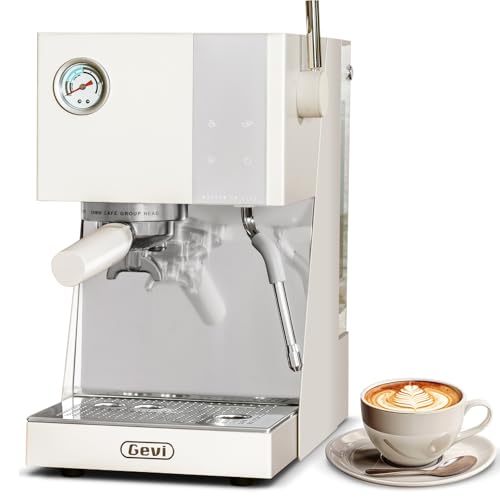
Gevi 58mm 20-Bar Espresso Machine
Best for: visual feedback and standard portafilter use
- Display
- LED Display
- Pump Pressure
- 20 bar
- Milk System
- Steam wand
- Features
- Milk Frother, 58mm Portafilter, Pressure Gauge
- Drink Type
- Cappuccino, Latte
- Color
- White
This Gevi machine uses a 20-bar pump and PID temperature control for consistent extraction. The LED display shows real-time shot timer, temperature, and pressure. It includes a 58mm portafilter and a steam wand for milk drinks. The unit measures 15.6 by 9.05 by 14.2 inches and weighs 21.6 pounds. It suits those who want visual feedback during brewing without a touchscreen interface.
- PID temperature control with three presets
- Real-time LED display for timer and pressure
- 58mm commercial portafilter for heat retention
- Built-in pressure gauge for monitoring
- Heavier build at 21.6 pounds
- Larger footprint than compact alternatives
- Fewer temperature settings than competitors with more granular control
- You prefer tactile LED feedback over touchscreens
- You want real-time pressure monitoring
- You need a 58mm portafilter for standard baskets
- You require a touchscreen interface
- You need a compact machine under 14 inches wide
- You want a grinder built into the unit
Verdict: Gevi 20 Bar Espresso Machine with LED Display fits users who value visual data and standard portafilter size. It is a solid choice for those avoiding touchscreens.
Specifications side by side
| Spec | AMZCHEF Espresso Machine with 44 Grind Settings | Gevi 58mm 20-Bar Espresso Machine |
|---|---|---|
| Pump Pressure | – | 20 bar |
| Built-In Grinder | 44 grind settings | – |
| Milk System | 8mm stainless steel steam wand | Steam wand |
| Features | Built-In Grinder, Milk Frother, Cold Brew | Milk Frother, 58mm Portafilter, Pressure Gauge |
| Drink Type | Cappuccino, Latte | Cappuccino, Latte |
| Color | Silver | White |
| Display | Touchscreen | LED Display |
| Brewing Method | Espresso | Espresso |
| Dimensions | 12.5 × 10.8 × 13.4 inches | 15.6 × 9.05 × 14.2 inches |
| Weight | 13.9 pounds | 21.6 pounds |
| Size | 44 Grind Settings | 9.05"W*15.55"D*14.17"H |
| Model | CM1626 | ECMN0-WH0A1 |
Frequently asked questions
Do touchscreen espresso machines offer better temperature control than LED models?
Yes, models with touchscreens often provide more precise digital adjustments. The AMZCHEF CM1626 features a touchscreen interface that supports digital temperature control. This allows you to set specific heat levels for consistent extraction. LED displays on other machines may show status but lack this level of granular input capability for heat management.
Which display type is better for monitoring pump pressure visually?
LED display machines are often better for visual pressure monitoring. The Gevi ECMN0-WH0A1 includes a dedicated pressure gauge alongside its LED display. This setup gives you clear, immediate feedback on extraction pressure. Touchscreen models may prioritize digital menus over analog gauges, which can make real-time pressure tracking less intuitive for some users.
Can I use a standard 58mm portafilter with an LED display machine?
Yes, the Gevi machine with an LED display supports a 58mm portafilter. This standard size allows you to use third-party baskets and accessories. The touchscreen AMZCHEF model does not explicitly list portafilter dimensions in its specifications. If you prefer standard commercial-style accessories, the LED model offers a clear advantage in compatibility.
Do touchscreen espresso machines include built-in grinders?
Some touchscreen models do include built-in grinders for convenience. The AMZCHEF CM1626 integrates a grinder with 44 adjustable settings directly into the unit. This saves counter space and simplifies your workflow. The Gevi LED display model does not list a built-in grinder in its specifications, requiring you to purchase a separate grinding device.
Which machine is smaller and lighter for small kitchens?
The AMZCHEF touchscreen model is more compact and lighter. It measures 10.8 inches wide and weighs 13.9 pounds. The Gevi LED display machine is larger, at 9.05 inches wide but significantly deeper and taller, weighing 21.6 pounds. If counter space is limited, the smaller footprint of the touchscreen model is more suitable.
Is cold brew functionality available on touchscreen espresso machines?
Yes, the AMZCHEF touchscreen model supports cold brew preparation. Its feature list explicitly includes cold brew capability alongside espresso and milk frothing functions. The Gevi LED display machine does not mention cold brew in its attributes. If you frequently make iced drinks, the touchscreen model provides this specific versatility without needing additional equipment.


